Interview Questions for Freshers: 15 Answers (2026)
The questions you'll actually be asked in your first job interview, and how to answer each one with a simple structure.
On this page
- Win the interview in your first few answers
- What questions do freshers get asked most?
- The 15 most common interview questions for freshers (with sample answers)
- 1. "Tell me about yourself"
- 2. "Why do you want this job?"
- 3. "Why should we hire you?"
- 4. "What are your strengths?"
- 5. "What is your biggest weakness?"
- 6. "Where do you see yourself in 5 years?"
- 7 to 15. The rest you should prepare
- How to answer any behavioural question: the STAR method
- What should freshers ask the interviewer?
- How long should interview answers be?
- 7 interview mistakes that cost freshers the offer
- How to prepare the night before
- Where to practise for real
- Ready to walk in prepared?
Win the interview in your first few answers
Most fresher interviews are won or lost in the first 10 minutes, on a short list of predictable questions. Learn the 15 below, answer each with a simple structure, and back every claim with one real example. Walking in, make sure your resume is sharp first, then browse open fresher roles to practise on real job descriptions.
What questions do freshers get asked most?
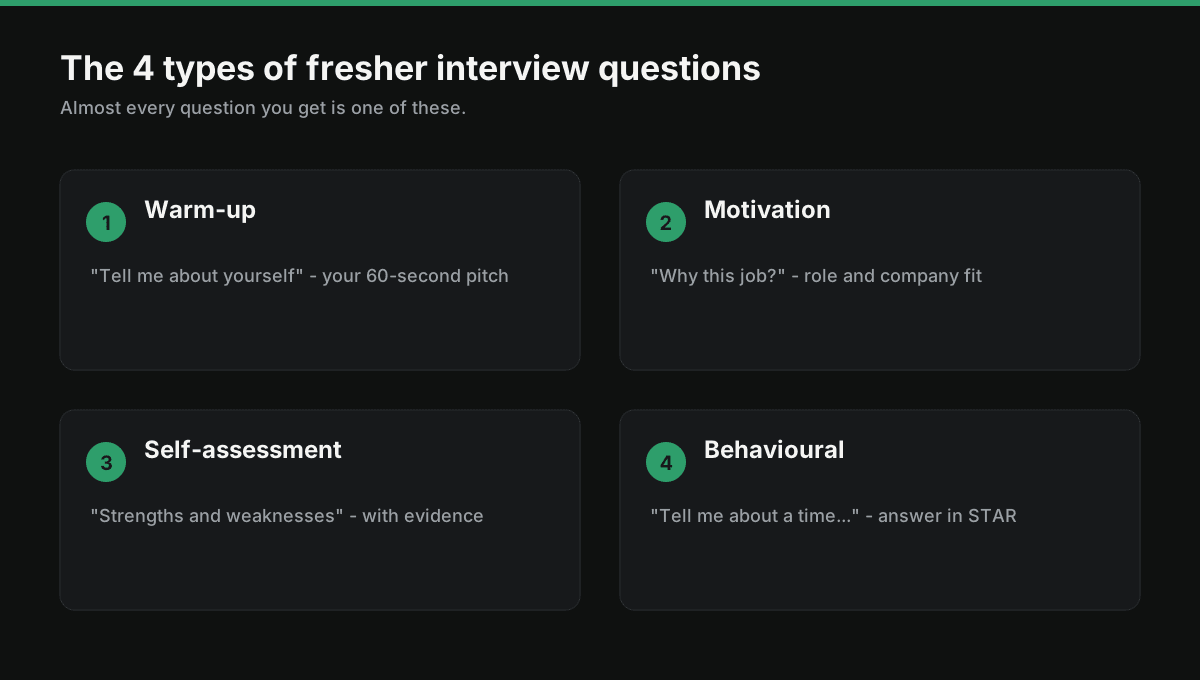
Fresher interviews usually mix four question types: a warm-up ("tell me about yourself"), motivation ("why this job?"), self-assessment ("strengths and weaknesses"), and behavioural ("tell me about a time..."). For your first 0 to 5 years, interviewers are testing attitude, clarity, and coachability more than deep experience, so structure and honesty beat jargon every time.
The 15 most common interview questions for freshers (with sample answers)
1. "Tell me about yourself"
Give a 60-second pitch, not your life story: what you studied, one or two things you have built, and what you want next. Keep it role-focused.
"I recently finished my degree in commerce, and during it I ran two college events and did a 2-month sales internship where I handled outreach. I enjoy talking to people and solving problems, so I am looking to start a full-time BD role."
2. "Why do you want this job?"
Connect the role to something specific about the company and to what you want to learn. Avoid "I need a job" or "good salary".
3. "Why should we hire you?"
Name two or three things you bring (a skill, a result, an attitude) and tie them to the job description. Confidence without arrogance.
4. "What are your strengths?"
Pick strengths the role actually needs, and prove each with one line of evidence.
"I am organised. In my internship I tracked 40+ leads in a simple sheet so nothing slipped, and my conversion was the highest on the team that month."
5. "What is your biggest weakness?"
Name a real but non-fatal weakness and show what you are doing about it. Never use a fake one like "I work too hard".
6. "Where do you see yourself in 5 years?"
Show ambition that fits the company: growing into more responsibility in the same function, not a job-hop plan.
7 to 15. The rest you should prepare
Prepare short, example-backed answers for these too: "What do you know about us?", "Why did you choose your field?", "How do you handle pressure?", "Tell me about a time you failed", "Tell me about a time you worked in a team", "How do you prioritise tasks?", "What motivates you?", "Are you willing to relocate?" (common for roles in Gurugram, Bengaluru, and Dubai), and "Do you have any questions for us?".
How to answer any behavioural question: the STAR method
When a question starts with "tell me about a time", answer in four beats: Situation, Task, Action, Result. Spend most of your time on Action and Result, and end with a number if you have one. STAR keeps you from rambling and makes your answer easy to follow.
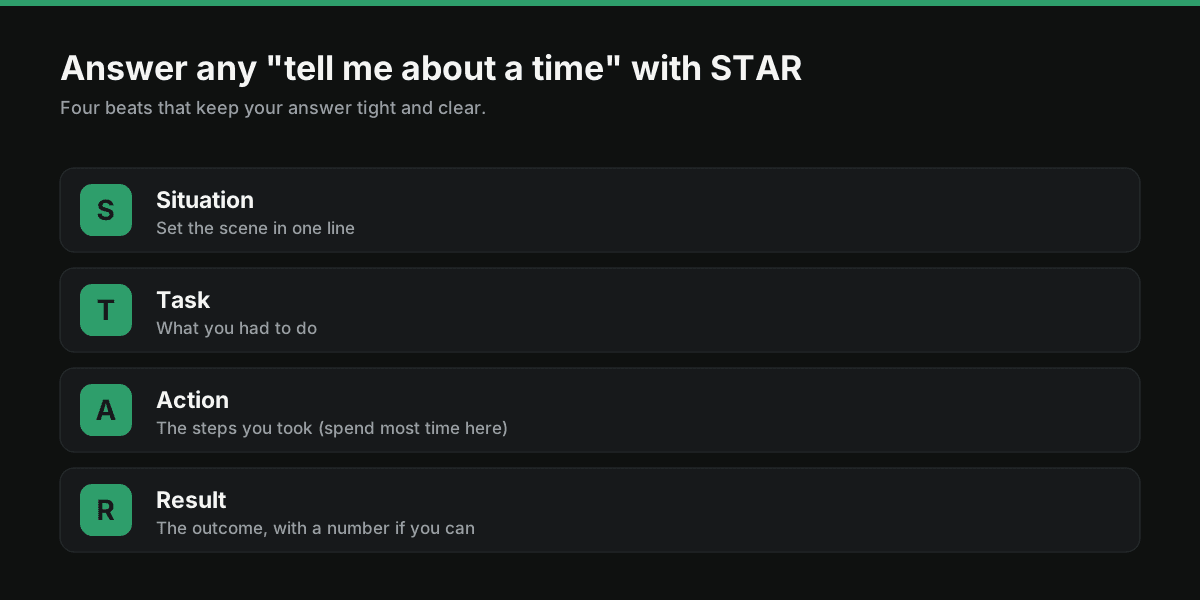
Situation: Our college fest was two weeks away with no sponsors. Task: I had to raise funds for the main event. Action: I listed 30 local businesses, pitched 12, and followed up with each. Result: I closed 3 sponsors for 45,000 rupees, enough to run the event.
What should freshers ask the interviewer?
Always have 2 or 3 questions ready; "no questions" reads as low interest. Good ones: "What does success look like in the first 90 days?", "How is the team structured?", and "What are the next steps?" Skip salary and leave policy in the first round unless they raise it.
How long should interview answers be?
30 to 90 seconds for most questions. Long enough to give a real example, short enough that the interviewer stays with you. If they want more, they will ask. Rambling past two minutes is the most common fresher mistake.
7 interview mistakes that cost freshers the offer
- Memorising answers word for word so you sound robotic.
- No specific examples, only adjectives.
- Talking money and leave in the first round.
- Bad-mouthing a past internship or college.
- Not researching the company.
- Having zero questions at the end.
- Weak basics: late, no greeting, no thank-you.
How to prepare the night before
Reread the job description and your own resume, write one STAR example for teamwork, failure, and leadership, prepare your 60-second intro out loud, pick two company facts, and keep three questions ready. Lay out your clothes and test your internet or route. Sleep beats cramming.
Where to practise for real
The fastest way to get comfortable is to interview for roles you actually want. Browse all open jobs for your first 0 to 5 years, or go by role: Sales & BD, Software Engineer, Finance, Marketing, Operations, and Design. You can also filter by city, from Gurugram and Bengaluru to Dubai.
Ready to walk in prepared?
The candidates who get offers are rarely the most experienced; they are the most prepared. Sharpen your resume, pick a few real roles, and rehearse these answers out loud until they sound like you.
→ Check your resume free on AiRA Careers
Questions people ask
What are the most common interview questions for freshers?
Expect a warm-up ("tell me about yourself"), motivation ("why this job?"), self-assessment ("strengths and weaknesses") and behavioural ("tell me about a time...") questions. Prepare a short, example-backed answer for each.
How do I answer "tell me about yourself" as a fresher?
Give a 60-second pitch: what you studied, one or two things you have built or done, and the role you want next. Keep it focused on the job, not your whole life story.
What is the STAR method in an interview?
STAR is a way to answer "tell me about a time" questions in four beats: Situation, Task, Action and Result. Spend most of your time on the action you took and the result, and add a number if you can.
AiRA Careers Team
Careers Editorial
The AiRA Careers team writes practical, India-first guides for people in their first 0 to 5 years of work. We draw on real recruiter feedback from across TheHireHub's hiring network so every tip is tested, not generic.